


When a loved one faces a medical crisis or someone is draining their money, a regular guardianship can take too long. A New York court can appoint a temporary guardian to act right away while the full case moves forward.
- New York calls it a temporary guardian, appointed under Mental Hygiene Law § 81.23 as part of an Article 81 guardianship case.
- The court can appoint one when the case starts, or at any time after, if there is danger in the reasonably foreseeable future to the person’s health and well-being, or of their property being wasted, taken or lost.
- A temporary guardian only has the specific powers the judge lists in the order.
- For adults, there is no way to get a guardian without a court. A valid power of attorney or health care proxy can sometimes make one unnecessary.
When a Guardianship Can’t Wait: How Temporary Guardians Work in New York
A standard adult guardianship under Article 81 follows set steps. The family files a petition in the Supreme Court, the judge signs an order to show cause, the person must be personally served at least 14 days before the hearing, and the hearing is held within 28 days of the order being signed. After the judge decides, the guardian still has to qualify before they can act. Our guide to adult guardianship in New York walks through each step.
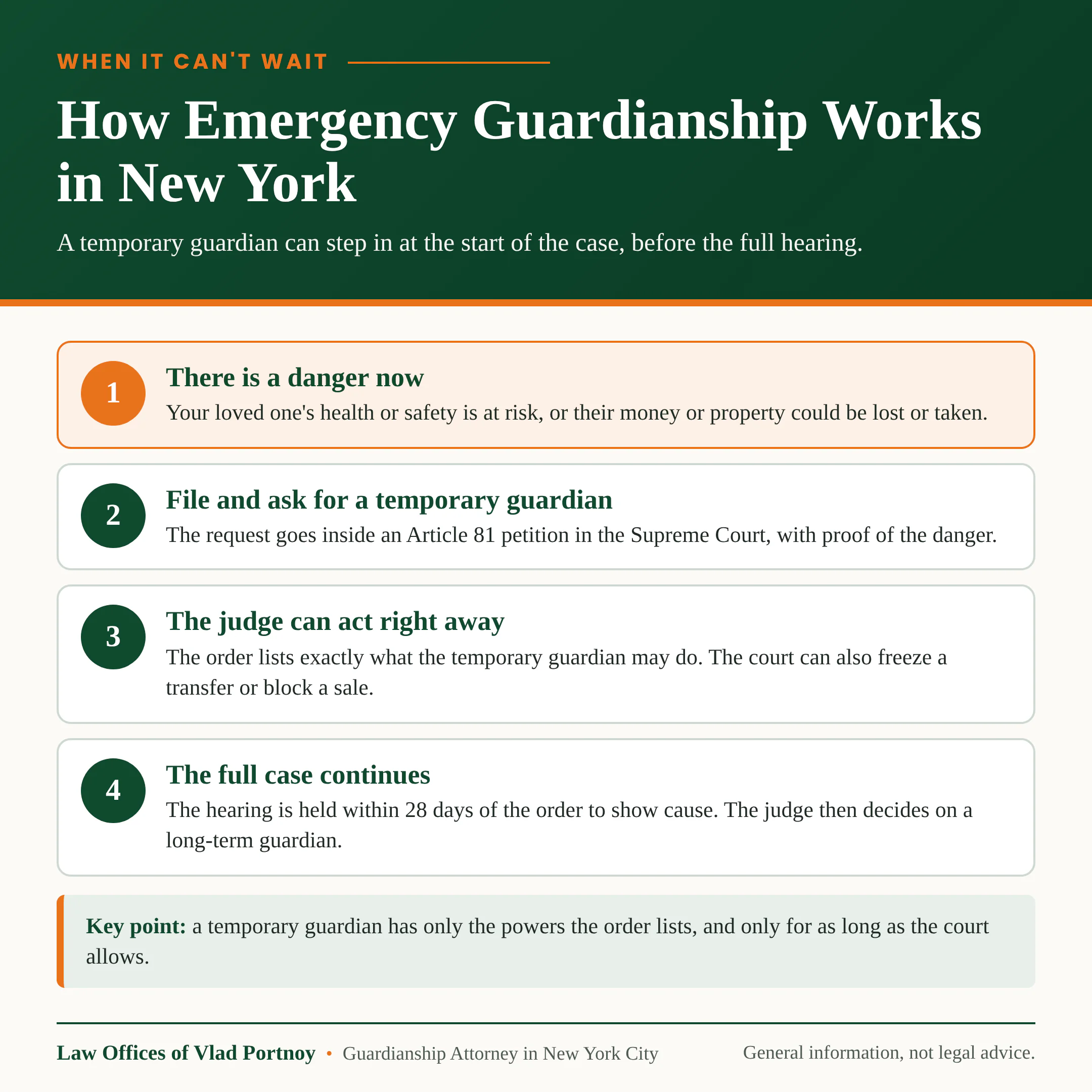
That timeline protects the person’s rights, but it can be too slow when something is about to go wrong. That is why the law lets the court act at the very start of the case. When the petition is filed, or at any time after, the judge can appoint a temporary guardian if there is a danger in the reasonably foreseeable future to the person’s health and well-being, or a danger that their property will be wasted, misappropriated or lost (§ 81.23).
Two things are important to understand:
- It is part of a guardianship case, not a shortcut around one. The request for a temporary guardian is made inside an Article 81 petition, and the full case continues afterward.
- The court can also act on property directly. Besides appointing a temporary guardian, the court can issue an injunction or a temporary restraining order, for example to stop a bank transfer or a sale while the case is pending (§ 81.23). When real estate is involved, the petitioner files a notice of pendency so the property can’t be sold out from under the person (§ 81.24).
When Does a Court Appoint a Temporary Guardian?
Courts appoint temporary guardians when waiting for the full hearing would put the person or their property at real risk. These are the situations families bring to us most often:
| Situation | What is at risk | What a temporary guardian might be allowed to do |
|---|---|---|
| A hospital discharge with no one able to sign | Health and safety | Approve a discharge plan, arrange home care or a safe placement |
| Money being taken by a caregiver, relative or scammer | Savings and income | Secure bank accounts and stop transfers |
| A home about to be sold, transferred or mortgaged | Real estate | Protect the property while the court decides |
| An urgent medical decision and no health care proxy | Health | Consent to a specific treatment or procedure |
| Unpaid rent, a pending eviction or utilities about to be shut off | Housing | Pay urgent bills and deal with the landlord or utility |
| A Medicaid or benefits application that can’t wait | Coverage for care | Gather records and sign the application |
| Neglect or abuse at home | Safety | Arrange safe care and services |
In practice, most emergency petitions involve an older adult with dementia, a sudden illness or injury, or financial exploitation that is happening right now. If you are dealing with a parent’s decline rather than a crisis, our guide to getting guardianship of a parent with dementia explains the path that usually fits better.
When a Temporary Guardian Is Usually Not Needed
- The danger is not imminent, and the full hearing within a few weeks is enough.
- A valid power of attorney or health care proxy already lets an agent act, and the agent is acting properly.
- Family members disagree, but no one’s health, safety or property is at immediate risk. Those cases are argued in the regular case; see contested guardianship.
How Long Does It Take to Get an Emergency Guardianship in New York?
There is no fixed number of days. Because the request can be made when the petition is filed, the judge can decide on a temporary guardian at the very start of the case, well before the full hearing. How fast it happens depends mostly on three things:
- The evidence of danger. Clear, recent medical and financial proof lets a judge act quickly. Vague concerns do not.
- Whether the paperwork is complete, including the petition, the proposed order and supporting affirmations.
- The court’s calendar in the county where the person lives.
What to Have Ready
| Document or information | Why it matters |
|---|---|
| Recent medical records or a doctor’s statement | Shows the person cannot manage the decision or the risk right now |
| Bank statements, notices or messages | Shows money being taken, a pending sale or bills that can’t wait |
| Any power of attorney, health care proxy or will | Shows whether an agent can already act, and who the person chose |
| Hospital or facility contacts, such as the social worker | They often know the discharge deadline and what the facility needs |
| Names and addresses of close family | They are entitled to notice of the case |
How Long Does a Temporary Guardianship Last?
A temporary guardianship is meant to be short. The judge’s order sets its limits, and it generally ends when the court decides the full guardianship petition or on the date the order sets. If the person needs ongoing help, the court appoints a permanent guardian at the end of the case, who may or may not be the same person.
What Powers Can a Temporary Guardian Have?
Only the ones the judge writes into the order. The law requires a temporary guardian’s powers and duties to be specifically listed, so the order is tailored to the emergency. Anything not listed stays outside their authority. Typical examples:
| Personal needs | Property and finances |
|---|---|
| Consent to a specific medical treatment | Access and secure specific bank accounts |
| Approve a hospital discharge plan | Stop a transfer or sale and protect real estate |
| Arrange home care or a safe placement | Pay urgent bills such as rent, utilities or care |
| Get access to medical records | Apply for Medicaid or other benefits |
Because the powers are narrow, a temporary guardian usually cannot make every decision a full guardian could. Larger decisions are left for the end of the case, when the court has heard from everyone. To see how a full guardian’s powers are set, read about the types of guardianship in New York.
A Narrower Option
Sometimes the problem is a single decision, such as signing one document or setting up care. If the person is found to need help, the court can approve a protective arrangement or single transaction instead of appointing a guardian (§ 81.16).
Can You Get Temporary Guardianship Without Going to Court?
For an adult, no. In New York, only a judge can appoint a guardian, temporary or permanent. But you may not need a guardian at all if one of these is already in place:
| Option | What it covers | The limit |
|---|---|---|
| Durable power of attorney | Banking, bills, property and benefits | Must have been signed while the person had capacity |
| Health care proxy | Medical decisions | Must have been signed while the person had capacity |
| Family as health care surrogate | Some medical decisions in hospitals and nursing homes when there is no health care proxy | Does not cover money, property or where the person lives |
| Social Security representative payee | Social Security benefits only | No authority over other income or decisions |
| Adult Protective Services | Investigates and arranges services for adults at risk who can’t protect themselves | Does not give a family member legal authority |
If none of these exist, or they don’t cover the emergency, a court petition is the way forward. Our comparison of power of attorney vs. guardianship explains when each one applies.
What About Temporary Guardianship of a Child?
Children are different. A parent can sign a Designation of Person in Parental Relation, which lets another adult make school and medical decisions for their child for a limited time without going to court (General Obligations Law § 5-1551). It does not transfer custody, and the parent can revoke it. Longer-term guardianship of a child goes through Family Court or Surrogate’s Court. Parents who want to plan ahead can also name a guardian in their will.
Need a Temporary Guardian Now? Talk to a New York Guardianship Lawyer
Emergencies leave little room for mistakes in the paperwork. Call us at (212) 920-6371 and tell us what is happening. We will tell you whether an emergency application makes sense or whether there is a faster way to protect your loved one, and we can prepare and file it with the court. Learn more about working with a guardianship attorney in NYC.
Emergency Guardianship FAQs
It is the common name for a temporary guardian appointed under Mental Hygiene Law § 81.23. When there is a danger in the reasonably foreseeable future to a person’s health and well-being or their property, the court can give someone limited, specific powers while the full guardianship case is decided.
Anyone who can file an Article 81 petition, including a family member, someone the person lives with, a person or agency concerned with their welfare, or the facility where they live. The request for a temporary guardian is made as part of that petition.
There is no fixed timeline. The request can be decided at the start of the case, well before the full hearing, and clear medical and financial evidence of danger helps the court act quickly.
Only as long as the court’s order allows. It generally ends when the court decides the full guardianship petition or on the date set in the order.
Only if the judge specifically allows it in the order. Temporary guardians usually receive narrow powers, such as protecting the home while the case is pending rather than selling it.
Yes. They can raise their objections in the guardianship case, and the full hearing still takes place. See our page on contested guardianship.
The law does not require one, but emergency applications depend on complete paperwork and clear evidence, and mistakes cost time you may not have.
It depends on the case. The general court costs and who usually pays are explained in our guide to guardianship costs in New York.